

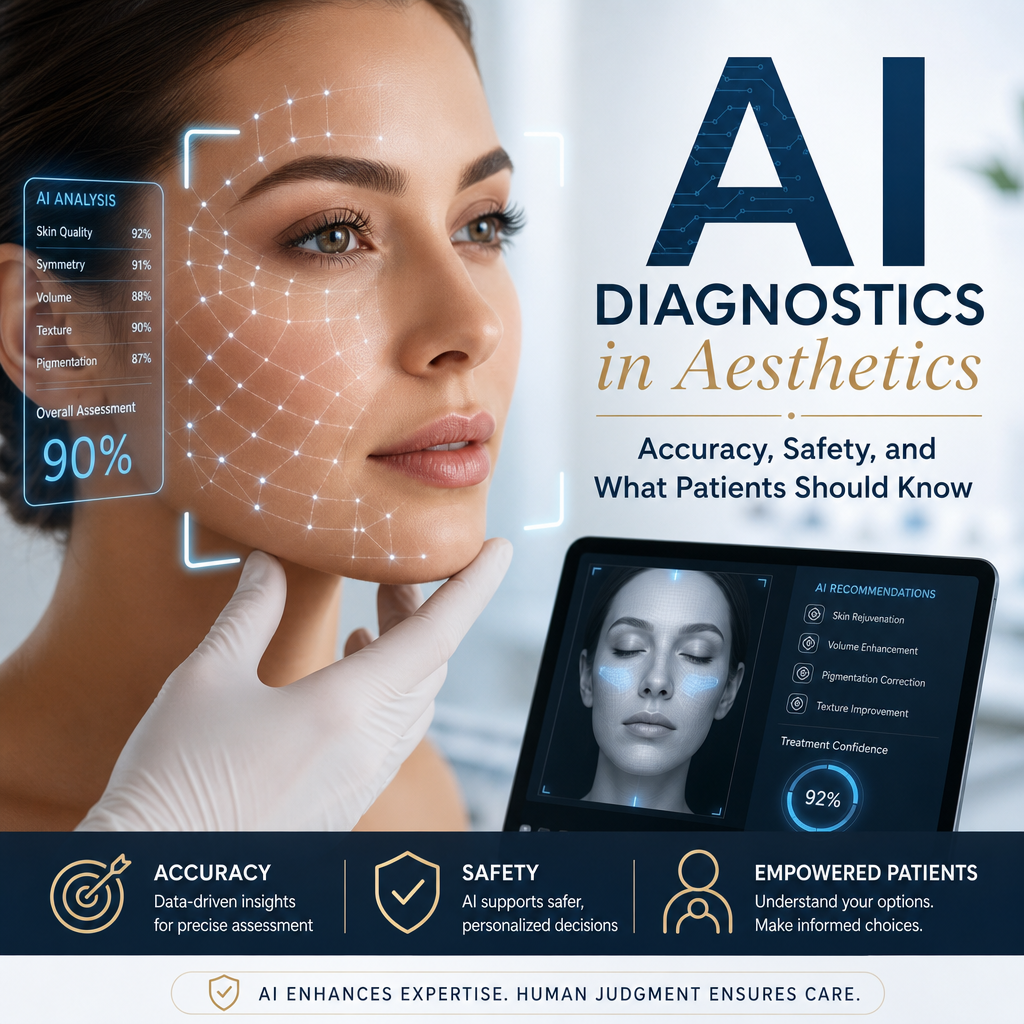
AI Diagnostics in Aesthetics: Accuracy, Safety, and What Patients Should Know
AI Diagnostics in Aesthetics: Accuracy, Safety, and What Patients Should Know
Artificial intelligence (AI) is reshaping many areas of medicine, and aesthetic practices are no exception. From automated skin analysis to simulated procedure outcomes, AI diagnostics in aesthetics promise faster assessments and personalized treatment plans. But how accurate and safe are these tools, and what should patients understand before relying on them? This post breaks down the key points patients need to know.
What “AI diagnostics in aesthetics” actually do
AI tools in aesthetics commonly perform one or more of the following tasks:
- Analyze photographs to evaluate skin conditions, asymmetry, or aging markers.
- Simulate post-procedure appearances (e.g., fillers, rhinoplasty).
- Triage patients by identifying cases needing specialist review.
- Track treatment progress over time with image comparison.
These systems typically use machine learning models trained on large image datasets and clinical labels to detect patterns a human might miss or to standardize assessments.
Accuracy: strengths and limits
AI can be highly accurate in narrow, well-defined tasks. Examples:
- Counting wrinkles or measuring skin lesion size can be precise when algorithms are trained on good-quality, standardized images.
- Simulations of filler effects can look realistic when based on comprehensive 3D modeling.
However, limitations exist:
- Performance depends on the quality and diversity of training data. Algorithms trained primarily on one skin type, age group, or ethnic background may perform poorly for others.
- Image capture variations (lighting, angle, camera quality) can degrade accuracy.
- Many AI models focus on appearance metrics rather than functional or subjective outcomes—what looks “ideal” to an algorithm may not align with a patient’s aesthetic goals.
When you hear claims like “98% accurate,” ask what that metric measures (sensitivity, specificity, overall accuracy), and whether it’s been validated on independent, real-world datasets.
Safety: where risk comes in
AI introduces unique safety considerations:
- Misdiagnosis or missed underlying medical conditions if AI focuses only on aesthetics.
- Over-reliance by clinicians who may accept AI outputs without sufficient skepticism.
- Inappropriate treatment plans based on flawed simulations or biased data.
Safeguards to look for include human clinician oversight, clear documentation of AI limitations, and protocols for second opinions or confirmatory clinical exams.
Bias and equity concerns
Bias in training data can perpetuate disparities. If an AI tool was trained mainly on lighter skin tones, it may under-detect conditions in darker skin. Similarly, models trained on younger populations can misinterpret age-related changes in older adults.
Ask whether the practice has validated the AI across diverse populations and whether any performance gaps were identified and addressed.
Privacy and data security
Image-based diagnostics require storage and processing of personal images—often highly sensitive. Patients should confirm:
- How images are stored and for how long.
- Whether images are anonymized before use in model training or improvement.
- If images are processed locally or sent to cloud servers, and which security standards are used (encryption, access controls).
- Whether they can opt out of having their images used for AI model development.
Clear informed consent detailing these points is essential.
Questions patients should ask their provider
Bring these questions to consultations to make informed decisions:
- Is the AI tool FDA-cleared or regulated in my country?
- Has this system been validated on patients like me (age, skin type, ethnicity)?
- Who reviews the AI results—will a clinician interpret and confirm them?
- Can you show examples of AI performance metrics and independent validation?
- How will my images and data be stored and used?
Practical tips when considering AI-guided aesthetic care
- Treat AI outputs as supportive, not definitive. Expect a human clinician to interpret results.
- Request before-and-after photos from similar cases, ideally with long-term follow-up.
- Seek clinics that are transparent about their AI tools, validation studies, and data policies.
- If a simulation seems too perfect or unrealistic, discuss expectations and constraints with your provider.
Final thoughts
AI diagnostics in aesthetics offer powerful tools for assessment, planning, and visualization. They can improve consistency and help patients understand potential outcomes. But accuracy varies by task and dataset, and safety depends on proper clinical oversight, validation, and ethical data handling. Patients who ask informed questions and prioritize transparency and human expertise will be best positioned to benefit from these technologies while minimizing risks.
