

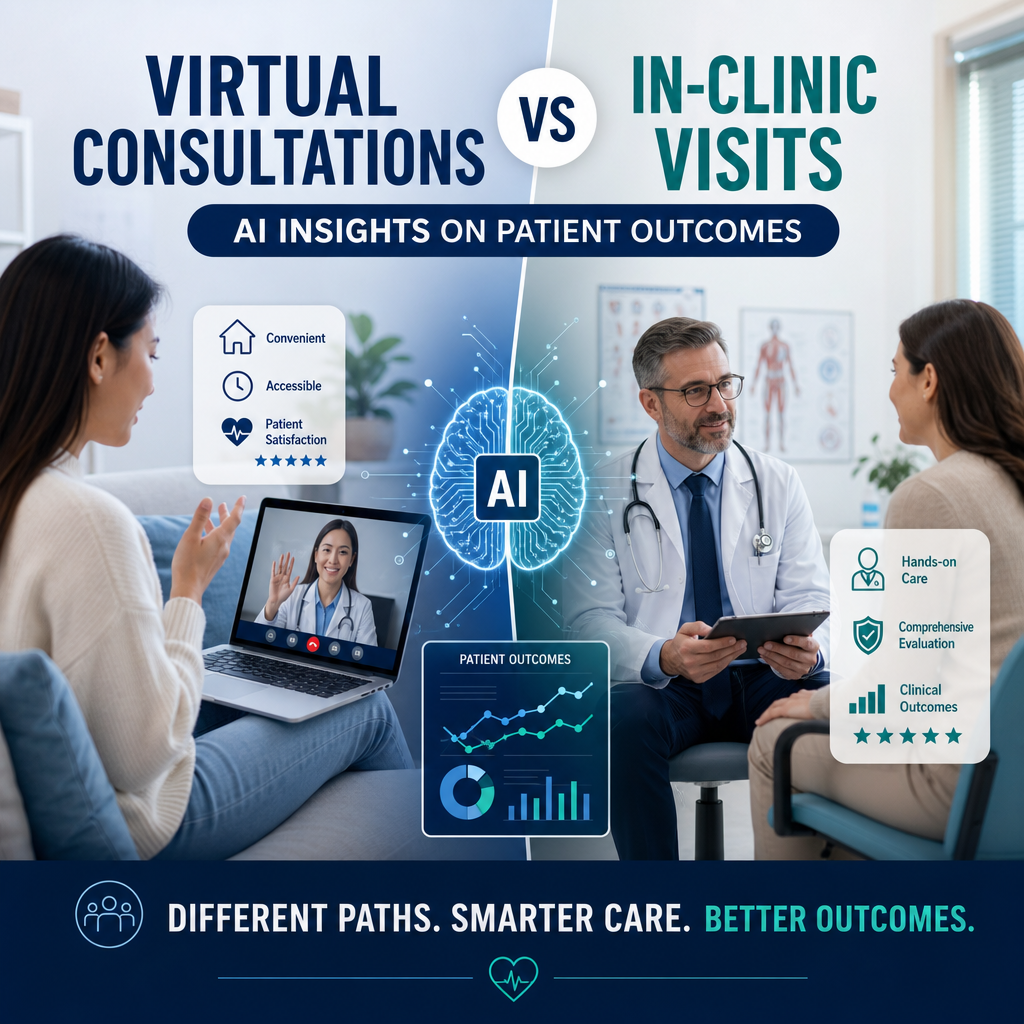
Virtual Consultations vs In-Clinic Visits: AI Insights on Patient Outcomes
Virtual Consultations vs. In‑Clinic Visits: What AI Reveals About Patient Outcomes
Telemedicine has grown from an emergency workaround to a mainstream care option. As virtual consultations become standard, artificial intelligence (AI) is starting to answer a core question: how do patient outcomes compare between virtual consultations vs. in‑clinic visits? AI can synthesize large datasets, identify patterns that humans miss, and help quantify differences across clinical effectiveness, access, and patient experience.
What AI brings to the comparison
AI contributes in three key ways:
- Aggregation: Machine learning models combine electronic health records (EHR), claims, remote monitoring, and patient-reported outcomes at scale.
- Pattern detection: AI identifies subtle correlations between encounter type and outcomes (e.g., readmission, disease control, adherence).
- Prediction and personalization: Predictive analytics estimate which patients will do well with virtual care and which need in-person evaluation.
These capabilities let researchers and health systems move beyond anecdote to evidence-based decisions about care modality.
Clinical outcomes: similar, with important caveats
AI-enabled analyses suggest that for many conditions, outcomes from virtual consultations are comparable to in‑clinic visits when patients are appropriately selected.
- Chronic disease management: For conditions like diabetes, hypertension, and depression, virtual follow-ups supported by remote monitoring and AI-driven alerts often achieve similar control of biomarkers and symptom scores as in‑person care.
- Acute complaints: For straightforward acute issues (e.g., uncomplicated urinary tract infections, upper respiratory infections), virtual visits often lead to similar resolution rates and low subsequent in-person escalation.
- Complex diagnostics and procedures: AI shows clear limits—cases requiring physical exams, imaging, or procedures have better outcomes when handled in-clinic.
AI can also detect subtle differences: some models show slightly higher antibiotic prescribing rates in virtual visits, while others reveal quicker time-to-treatment for urgent issues due to telehealth accessibility.
Patient experience and access
AI findings underscore that virtual consultations improve access and patient satisfaction, especially for:
- Rural and mobility-limited patients
- Busy working adults and caregivers
- Mental health and behavioral health populations
Sentiment analysis on patient feedback and natural language processing of notes reveal higher convenience scores for virtual encounters. However, AI also identifies disparities: older adults, low-income patients, and those without broadband are less likely to benefit equally, which can widen health inequities without deliberate interventions.
Cost, utilization, and system-level outcomes
From a system perspective, AI analyses indicate:
- Reduced no-show rates and shorter time-to-visit for virtual care.
- Potential reductions in emergency department use when virtual triage is available.
- Mixed evidence on total utilization—some systems see increased follow-up visits when virtual care lowers the barrier to access, which can raise short-term costs.
By modeling care pathways, AI helps health systems design hybrid workflows that preserve cost-effectiveness while maintaining quality.
Diagnostic accuracy and safety signals
AI tools examining diagnostic codes, subsequent care, and adverse events find that diagnostic accuracy in virtual consultations is generally acceptable for selected conditions. However:
- Missed findings happen more often when physical exam or imaging would have changed management.
- AI-driven risk stratification can flag patients at higher risk who should be prioritized for in-person follow-up, improving safety.
Combining clinician judgment with AI recommendations reduces missed diagnoses and optimizes triage.
Limitations of AI insights
AI offers powerful insights but has constraints:
- Data bias: Models trained on EHR data reflect existing access patterns and may perpetuate disparities.
- Quality and completeness: Remote monitoring and telehealth notes can be inconsistent; poor data quality undermines model conclusions.
- Generalizability: Findings from one health system or population may not apply universally.
Responsible interpretation requires transparency about model limitations and validation across diverse settings.
Practical takeaways for clinicians and administrators
- Use AI-driven risk stratification to decide which patients are appropriate for virtual consultations and which need in-person care.
- Pair virtual visits with remote monitoring, EHR-integrated decision support, and clear escalation pathways to improve outcomes.
- Monitor equity metrics and invest in digital access (e.g., broadband, devices, digital literacy) to prevent widening gaps.
- Adopt a hybrid care model: leverage telehealth for follow-up, triage, and chronic disease management, reserving in-clinic visits for procedural, diagnostic, or complex needs.
Conclusion
AI reveals that virtual consultations can match in-clinic visits for many patient groups when implemented thoughtfully. The keys to equal or better patient outcomes are appropriate patient selection, robust data and monitoring, and attention to equity. With AI as a guide, health systems can design hybrid care pathways that combine the best of virtual and in‑clinic care to improve outcomes, access, and patient experience.
