

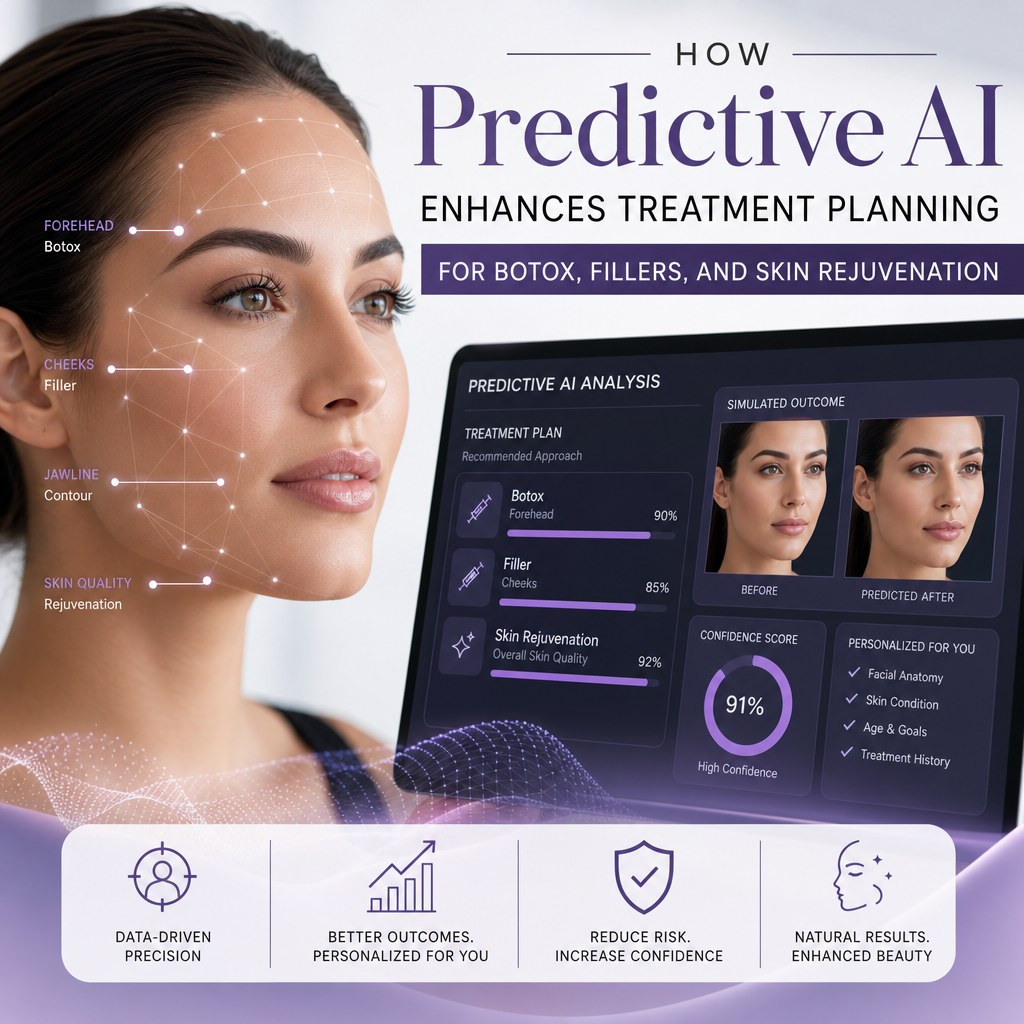
How Predictive AI Enhances Treatment Planning for Botox, Fillers, and Skin Rejuvenation
How Predictive AI Enhances Treatment Planning for Botox, Fillers, and Skin Rejuvenation
Predictive AI is changing the way clinicians and patients approach aesthetic treatments. By combining imaging, patient data, and machine learning, predictive tools provide clearer expectations, personalized protocols, and measurable improvements in safety and outcomes for Botox, fillers, and skin rejuvenation procedures.
What predictive AI brings to aesthetic planning
Predictive AI uses historical and real-time data to forecast outcomes. In aesthetics, that means predicting how a patient’s face will respond to injectables, which areas will age fastest, and which combination of treatments will produce the best results. The technology supports decision-making at every stage: consultation, treatment selection, dosing, and follow-up.
Key benefits include:
- More accurate outcome simulations for patient consultations.
- Personalized dosage and combination therapy recommendations.
- Identification of risk factors for adverse events like bruising or vascular compromise.
- Objective tracking of progress and longevity of results.
How it works: data sources and models
Predictive AI relies on multiple data inputs:
- High-resolution 2D and 3D facial imaging.
- Skin analysis metrics (texture, pigmentation, elasticity).
- Patient demographics and medical history.
- Prior treatment records and outcome assessments.
- Lifestyle factors (smoking, sun exposure, medication).
Machine learning and deep learning models analyze this data to detect patterns that humans cannot easily see. Examples include:
- 3D morphologic analysis to predict volumetric changes after fillers.
- Skin aging trajectory models that estimate future wrinkle development.
- Risk-scoring algorithms that predict likelihood of bruising or prolonged edema.
Practical applications in Botox and fillers
Predictive AI enhances clinical choices in several concrete ways:
- Outcome simulation: Clinicians can show patients a likely post-treatment appearance under different scenarios (e.g., 1 syringe vs. 2 syringes), improving informed consent and satisfaction.
- Dose optimization: Models recommend personalized units of Botox or filler volume based on muscle activity, tissue thickness, and previous response patterns.
- Combination planning: Algorithms suggest synergistic pairings—such as neuromodulator plus volumizer plus skin resurfacing—to maximize aesthetic goals with minimal interventions.
- Risk mitigation: AI flags anatomical variations and vascular hotspots to reduce the risk of complications with injectable procedures.
Skin rejuvenation and long-term planning
For skin rejuvenation, predictive AI helps design staged treatment plans by forecasting aging progression and treatment durability. It can:
- Estimate the longevity of laser, microneedling, or topical regimens for individual patients.
- Prioritize interventions (e.g., pigment correction first, then resurfacing) for the most efficient path to improvement.
- Recommend maintenance schedules tailored to predicted rate of relapse or recurrence.
These capabilities allow clinicians to move from generic protocols to dynamic, patient-specific care plans that evolve over time.
Improving patient experience and practice efficiency
Predictive AI also benefits clinic operations and patient satisfaction:
- Faster consultations with evidence-backed visualizations.
- Reduced touchdown visits due to more accurate first-time results.
- Better patient education and realistic expectation setting.
- Data-driven follow-up that personalizes maintenance intervals and adds value to aftercare.
Limitations, validation, and ethical considerations
Predictive models are only as good as their data. Key considerations include:
- Clinical validation: Models must be validated against diverse populations and peer-reviewed datasets to avoid bias.
- Explainability: Clinicians should understand and be able to explain AI recommendations to patients.
- Privacy and consent: Patient imaging and medical data must be secured and used transparently.
- Regulatory compliance: Devices and software used for clinical decision-making may require regulatory review.
Despite these challenges, properly developed and validated tools can be safe, effective adjuncts to clinical judgment—not replacements.
Looking ahead: the future of AI in aesthetic medicine
As datasets grow and algorithms improve, predictive AI will become more adept at multi-modal planning—integrating genetics, biomarkers, and lifestyle predictors into aesthetic strategies. Expect tighter integration with clinic imaging systems, automated outcome tracking, and increasingly personalized roadmaps for preserving youthfulness and skin health.
Predictive AI is already enhancing treatment planning for Botox, fillers, and skin rejuvenation by making care more personalized, safer, and outcome-focused. When combined with clinician expertise and ethical practices, it promises better results and greater patient confidence in aesthetic treatments.
