

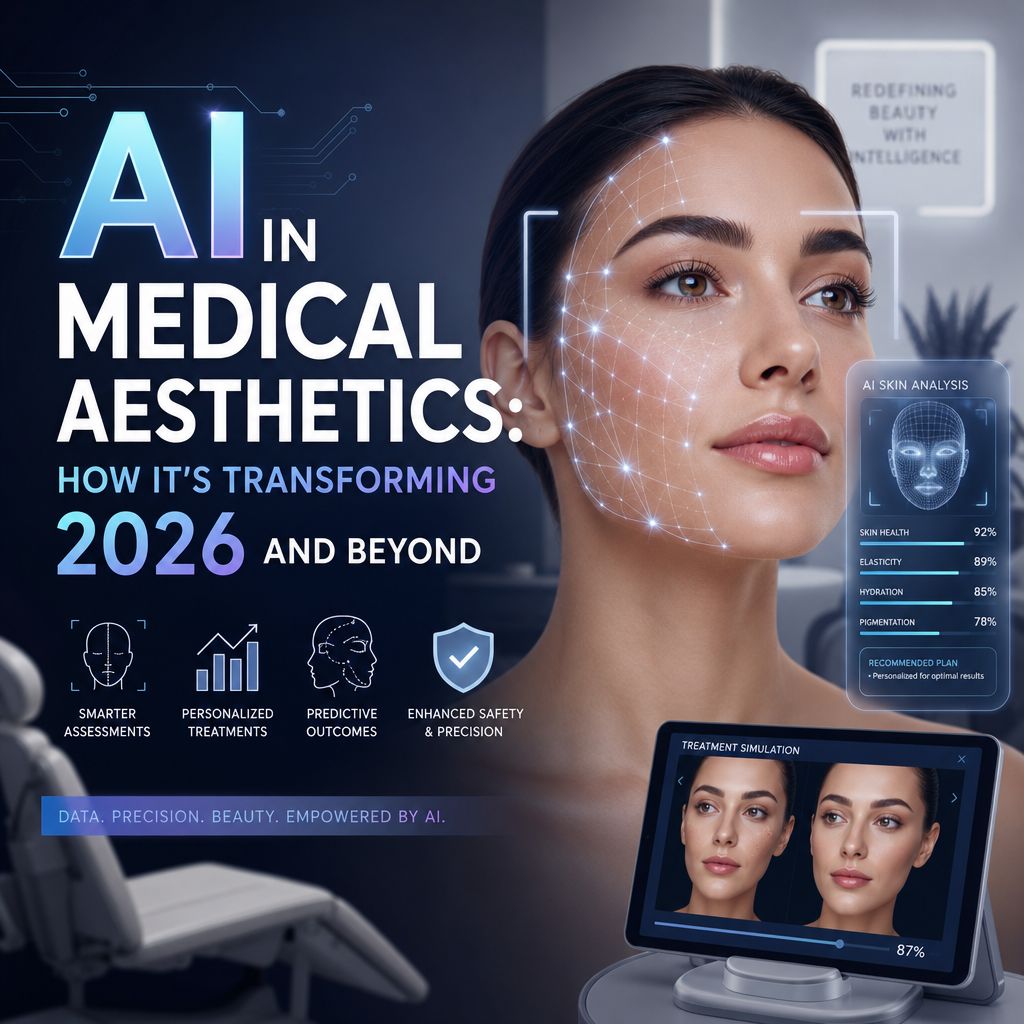
AI in Medical Aesthetics: How It’s Transforming 2026 and Beyond
How AI Is Transforming the Future of Medical Aesthetics in 2026 and Beyond
Artificial intelligence is rapidly reshaping medical aesthetics, bringing precision, personalization, and efficiency to an industry built on appearance and patient experience. From smart diagnostics to AI-guided procedures, understanding how AI is transforming the future of medical aesthetics in 2026 and beyond helps clinicians and patients set realistic expectations and embrace practical innovations.
Smarter diagnostics and personalized treatment plans
Computer vision and deep learning models now analyze skin, tissue quality, and facial structure with accuracy that rivals experienced clinicians. AI tools can:
- Detect subtle skin conditions, pigmentation patterns, and early signs of aging from photos and dermatoscopic images.
- Quantify volume loss, asymmetries, and structural changes to inform filler or surgical planning.
- Predict likely outcomes of different interventions using large datasets of before-and-after results.
This level of analysis supports highly personalized treatment plans. Instead of a one-size-fits-all approach, clinicians can tailor modalities, dosages, and sequencing to each patient’s anatomy and predicted response.
Enhanced procedural precision with robotics and real-time feedback
AI-driven robotics and handheld devices are improving procedural accuracy and safety. Examples include:
- Robotic arms or assisted devices that maintain steady trajectories for injections or laser passes.
- Ultrasound-guided AI systems that map vascular anatomy in real time, reducing the risk of vascular occlusion during filler injections.
- Laser systems that adapt energy and pulse patterns based on continuous AI evaluation of tissue response.
Real-time feedback loops let clinicians adjust in the moment, improving outcomes and reducing complications.
Better patient visualization and informed consent
AI-powered simulation platforms give patients realistic previews of expected results. Using generative models and 3D reconstruction, these tools can:
- Show probable outcomes for injectables, lifts, and contouring procedures.
- Simulate aging progression to guide long-term planning.
- Allow side-by-side comparisons of procedural choices.
These visualizations improve shared decision-making and set more accurate expectations, which tends to increase satisfaction and reduce revision rates.
Telemedicine, remote monitoring, and continuity of care
Tele-aesthetics is evolving beyond a consult: AI enables remote triage, progress tracking, and early complication detection. Capabilities include:
- Automated assessment of healing and infection signs from patient-submitted images.
- Chatbots that triage concerns and escalate to clinicians when needed.
- Predictive alerts for patients at higher risk of adverse events based on historical data.
Remote monitoring extends care beyond the clinic, making follow-up more consistent and proactive.
Operational efficiency and business impact
AI streamlines many non-clinical aspects of medical aesthetic practices:
- Scheduling optimization to maximize utilization while reducing no-shows.
- Automated documentation and coding, freeing clinicians from administrative burdens.
- Marketing analytics that match services to patient demographics and preferences.
These efficiencies lower costs, improve patient throughput, and create more time for hands-on care.
Safety, ethics, and regulatory considerations
As AI tools enter clinical practice, robust validation and oversight are essential. Key concerns include:
- Clinical validation: AI models must be tested across diverse populations to avoid biases in outcomes.
- Regulatory compliance: Many AI medical tools qualify as software as a medical device (SaMD) and require regulatory clearance.
- Data privacy: High-resolution images and biometric data demand secure storage and informed consent.
Human oversight remains critical—AI should augment, not replace, clinical judgment.
What to expect in 2026 and beyond
By 2026, expect wider adoption of validated AI tools integrated into workflows. Trends likely to accelerate include:
- Seamless AI-assisted treatment planning embedded in electronic health records.
- Expanded use of augmented reality in consultations and intra-procedural guidance.
- Greater standardization of outcome metrics driven by AI analytics, improving evidence-based practice.
Longer term, continuous learning systems trained on federated datasets will improve personalization while preserving patient privacy.
Conclusion
How AI is transforming the future of medical aesthetics in 2026 and beyond is apparent across diagnostics, procedural safety, patient experience, and practice operations. When implemented responsibly—with clinical validation, ethical safeguards, and human oversight—AI enhances outcomes, reduces risk, and expands access. For practitioners and patients alike, the promise is a more precise, predictable, and personalized era of aesthetic medicine.
